Pretty regularly, I read or read a discussion of how technology is forging new ground, either for good or ill. But either way, it's all new and therefore we have no idea how it will turn out, etc.
Except far too often that's not true. Maybe I look at things too broadly (e.g. I think bound paper things are relatively interactive), but I see lots and lots and lots of parallels throughout history.
One example that has stuck with me is the development of the spreadsheet (like Excel, but it very much wasn't the first one). There are a number of pundits that say not just that VisiCalc was the first killer app, but that it was developed from whole cloth. Nothing existed like it before. Except it did. Go look up how to use a ledger book. They're not even like slide rules or abacuses (abacaii?) and are still sold at, based on the variety, a pretty good clip.
Another is the ongoing discussion of the future of news media. The old-school reporting staff and well-curated model is, well, old and traditional. What ever will happen to us when this all new world of information gathered from anyone who wants to write up their version of events, from eyewitnesses, and so on? Well, maybe the same thing that happened in the early days of papers, when that's just where the content came from. They'd just print letters on the front page, and often multiple conflicting accounts with no overview or attempt to rectify it. What will the whole world be like when it's nothing but aggregators of individual articles like this?
And I'm not even just being a naysayer here. You can learn valuable lessons from these history lessons. Spreadsheets were designed to be computerized ledgers, adding a few shortcuts to increase accuracy and efficiency like calculation. But that has empowered them to be even more capable, in ways that could not have been predicted. News in the old days
More recently, I've been reading this history of the development of the Mac and considering how they came to these decisions on UI which we now see as being fundamental truths. And I often like to re-visit the early history of computing (later chapters are not as good) to remind myself of the difficulties they had in creating computers in the face of tabulating machines.
You did know tabulating machines were not computers, right? If not, get out and read some more. There's all sorts of good history out there, that tells you why things are the way they are, and which you can put to use when making design decisions about contemporary interactive products.
Now, back to writing my own -- hopefully sufficiently short and comprehendible -- history and explanation of the basics of mobile telephony as an appendix to the forthcoming book on Designing Mobile Interfaces.
Showing posts with label computers. Show all posts
Showing posts with label computers. Show all posts
Monday, June 20, 2011


Wednesday, November 10, 2010
More on Context: Musing on Multiple Screens
Aside from spending all my time looking for work (please hire me!) or writing in excessive detail about mobile design, I've been slowly noticing myself doing things like this:
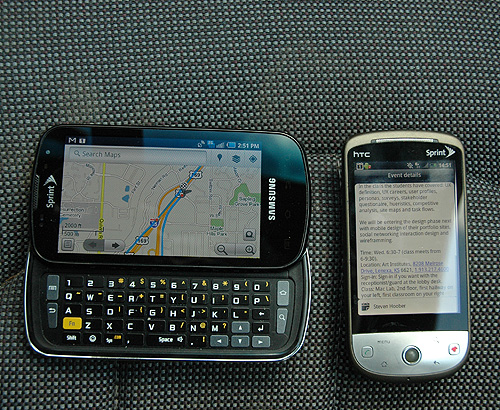 I have a couple additional handsets that are active (thanks, various old clients), and I sometimes carry the extras around. And I find myself not so much switching to the coolest, newest one, but using all the tools I have available, often at the same time.
Yes, they now all multitask just fine, so why am I doing this? At first I thought it was just that I'd found something else to gripe about. The switching is bad. Or they don't link up well so I might as well be typing. But I don't think that's it.
Because when I started becoming conscious of this, I noticed doing it a lot more. And in all sorts of places. Like this.
I have a couple additional handsets that are active (thanks, various old clients), and I sometimes carry the extras around. And I find myself not so much switching to the coolest, newest one, but using all the tools I have available, often at the same time.
Yes, they now all multitask just fine, so why am I doing this? At first I thought it was just that I'd found something else to gripe about. The switching is bad. Or they don't link up well so I might as well be typing. But I don't think that's it.
Because when I started becoming conscious of this, I noticed doing it a lot more. And in all sorts of places. Like this.
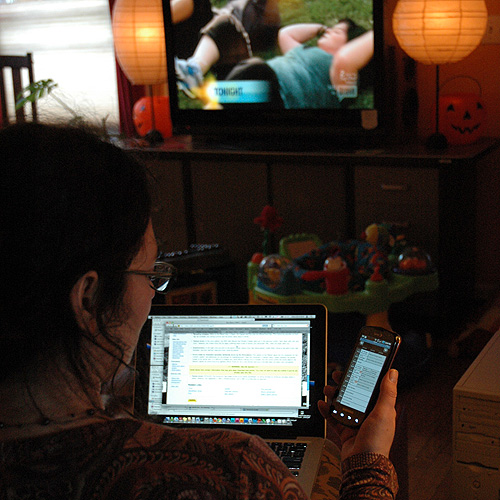 For example, I'm watching something on the DVR with the family, and using the Sling-provided function to see what is on the DVR (to make sure the show we want is being recorded, to find out what we can watch next) without interrupting the viewing, and using the computer to read the IMdB page about the movie for other types of entertainment. And that's not even counting doing Facebook or Email or Twitter or blogging while watching TV. Very often, I am extending the experience with another device.
And yes, sometimes I do that with more than one handset, instead of a computer. But I am not sure it matters. A few others have been talking about use of multiple screens lately. Most notably, I'll mention these two posts by Russell Davies (no, not that one) on using multiple handsets, and ancillary screens. And I've known people for years who are similarly issued a work phone (perhaps a high-security one), and have a normal phone for the rest of their lives. And I haven't even gotten to iPods, in-car navigation, kiosks or those annoying video-playing screens on gas pumps.
But back to what it means: I am not sure. Working on it, but it helps to type things, and maybe you can contribute.
I am sorta thinking along two paths now. First, the "fourth screen" thing may not be what I think a lot of tech pundits seems to want ("Technology Y is Dead!"), which is generational improvements, but /additional/ types of interfaces. And they don't necessarily displace, but can be used in addition. Like my use of mobile and computer while watching TV.
The other is about context. Where, again, I think I work best with photos.
For example, I'm watching something on the DVR with the family, and using the Sling-provided function to see what is on the DVR (to make sure the show we want is being recorded, to find out what we can watch next) without interrupting the viewing, and using the computer to read the IMdB page about the movie for other types of entertainment. And that's not even counting doing Facebook or Email or Twitter or blogging while watching TV. Very often, I am extending the experience with another device.
And yes, sometimes I do that with more than one handset, instead of a computer. But I am not sure it matters. A few others have been talking about use of multiple screens lately. Most notably, I'll mention these two posts by Russell Davies (no, not that one) on using multiple handsets, and ancillary screens. And I've known people for years who are similarly issued a work phone (perhaps a high-security one), and have a normal phone for the rest of their lives. And I haven't even gotten to iPods, in-car navigation, kiosks or those annoying video-playing screens on gas pumps.
But back to what it means: I am not sure. Working on it, but it helps to type things, and maybe you can contribute.
I am sorta thinking along two paths now. First, the "fourth screen" thing may not be what I think a lot of tech pundits seems to want ("Technology Y is Dead!"), which is generational improvements, but /additional/ types of interfaces. And they don't necessarily displace, but can be used in addition. Like my use of mobile and computer while watching TV.
The other is about context. Where, again, I think I work best with photos.
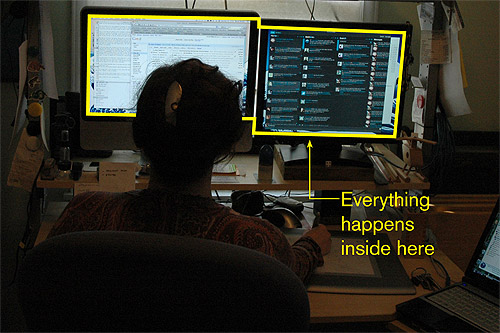 The desktop, as I've mentioned lately when discussing context, is about what happens on the big glowing rectangle. It can assume you are sitting right in front of it, and all the interaction happens in windows within the display rectangle (or, to me, two adjacent rectangles). Laptops are not much different, and still assume they are more important than the surroundings.
You don't carry a screen around with you out in the world, but can carry (or place, or mount) an arbitrary number of screens in the context in which you live; the whole world.
Previously, I had really considered context to be a screen bound to the viewport or device and strongly influenced by the way the user worked, and the environment they live in. Even though I have drawn pictures of the device in context, I wasn't quite getting that it literally lives in the context of the rest of the world.
So, I have yet to decide how this impacts how I might design a service. Certainly somehow, at least for entertainment and CE products. And probably some for everything else. If I come up with more, expect to see additional ranting, or topics in the book. I think there might be something to say about remote input as well.
To which I'll remind everyone: please visit, provide feedback and contribute to the mobile design patterns and information wiki at 4ourth Mobile.
The desktop, as I've mentioned lately when discussing context, is about what happens on the big glowing rectangle. It can assume you are sitting right in front of it, and all the interaction happens in windows within the display rectangle (or, to me, two adjacent rectangles). Laptops are not much different, and still assume they are more important than the surroundings.
You don't carry a screen around with you out in the world, but can carry (or place, or mount) an arbitrary number of screens in the context in which you live; the whole world.
Previously, I had really considered context to be a screen bound to the viewport or device and strongly influenced by the way the user worked, and the environment they live in. Even though I have drawn pictures of the device in context, I wasn't quite getting that it literally lives in the context of the rest of the world.
So, I have yet to decide how this impacts how I might design a service. Certainly somehow, at least for entertainment and CE products. And probably some for everything else. If I come up with more, expect to see additional ranting, or topics in the book. I think there might be something to say about remote input as well.
To which I'll remind everyone: please visit, provide feedback and contribute to the mobile design patterns and information wiki at 4ourth Mobile.
I have a couple additional handsets that are active (thanks, various old clients), and I sometimes carry the extras around. And I find myself not so much switching to the coolest, newest one, but using all the tools I have available, often at the same time.
Yes, they now all multitask just fine, so why am I doing this? At first I thought it was just that I'd found something else to gripe about. The switching is bad. Or they don't link up well so I might as well be typing. But I don't think that's it.
Because when I started becoming conscious of this, I noticed doing it a lot more. And in all sorts of places. Like this.
For example, I'm watching something on the DVR with the family, and using the Sling-provided function to see what is on the DVR (to make sure the show we want is being recorded, to find out what we can watch next) without interrupting the viewing, and using the computer to read the IMdB page about the movie for other types of entertainment. And that's not even counting doing Facebook or Email or Twitter or blogging while watching TV. Very often, I am extending the experience with another device.
And yes, sometimes I do that with more than one handset, instead of a computer. But I am not sure it matters. A few others have been talking about use of multiple screens lately. Most notably, I'll mention these two posts by Russell Davies (no, not that one) on using multiple handsets, and ancillary screens. And I've known people for years who are similarly issued a work phone (perhaps a high-security one), and have a normal phone for the rest of their lives. And I haven't even gotten to iPods, in-car navigation, kiosks or those annoying video-playing screens on gas pumps.
But back to what it means: I am not sure. Working on it, but it helps to type things, and maybe you can contribute.
I am sorta thinking along two paths now. First, the "fourth screen" thing may not be what I think a lot of tech pundits seems to want ("Technology Y is Dead!"), which is generational improvements, but /additional/ types of interfaces. And they don't necessarily displace, but can be used in addition. Like my use of mobile and computer while watching TV.
The other is about context. Where, again, I think I work best with photos.
The desktop, as I've mentioned lately when discussing context, is about what happens on the big glowing rectangle. It can assume you are sitting right in front of it, and all the interaction happens in windows within the display rectangle (or, to me, two adjacent rectangles). Laptops are not much different, and still assume they are more important than the surroundings.
You don't carry a screen around with you out in the world, but can carry (or place, or mount) an arbitrary number of screens in the context in which you live; the whole world.
Previously, I had really considered context to be a screen bound to the viewport or device and strongly influenced by the way the user worked, and the environment they live in. Even though I have drawn pictures of the device in context, I wasn't quite getting that it literally lives in the context of the rest of the world.
So, I have yet to decide how this impacts how I might design a service. Certainly somehow, at least for entertainment and CE products. And probably some for everything else. If I come up with more, expect to see additional ranting, or topics in the book. I think there might be something to say about remote input as well.
To which I'll remind everyone: please visit, provide feedback and contribute to the mobile design patterns and information wiki at 4ourth Mobile.
Tuesday, December 16, 2008
Marketing usually trumps technology
About the early (like, soldering-things-together-in-their-living-room early) history of Cisco, the internet hardware and software company. Much of the product was software based, and with early networking no one even knew exactly why they needed such stuff.
"Cisco cleverly sold software that plugged into the wall, had a fan and got warm,'' Gorin said. "People had a long history of buying things that plugged into the wall, made noises and got warm.''Interesting history in general. From here: http://pdp10.nocrew.org/docs/cisco.html
Tuesday, October 9, 2007
Design DVD
I subscribe to some of the netflix rss feeds, including the new releases one. Why do you think I have 1200 disks spread over half a dozen queues? So much neat stuff comes out. Anyway, I saw this Design disk (or,
on netflix and couldn't resist. Got it and pushed to the top of the queue.
 It was really neat, and very interesting for any designer, despite focusing on dimensional products. While they were all produced by the same people, in the same style, each product was a free-standing segment, so I'll briefly cover them each that way.
The DS19, turns out to be the epitome of the Citroen, the one that I suspect all Americans hate, with the rear axle way at the back. But its still really interesting seeing how Flaminio Bertoni changed stodgy designs, and more or less invented some of the modern auto methods of modeling cars in clay, for example.
Nice addressing of function, not just form, and problem solving (like chopping off the back of the car to fit it into typical garages, then hiding the odd shapes with lighting enclosures) and even production troubles.
This one had no talking heads, presumably because all the designers are long dead, but it does ask for a bit of trust to the narrator.
It was really neat, and very interesting for any designer, despite focusing on dimensional products. While they were all produced by the same people, in the same style, each product was a free-standing segment, so I'll briefly cover them each that way.
The DS19, turns out to be the epitome of the Citroen, the one that I suspect all Americans hate, with the rear axle way at the back. But its still really interesting seeing how Flaminio Bertoni changed stodgy designs, and more or less invented some of the modern auto methods of modeling cars in clay, for example.
Nice addressing of function, not just form, and problem solving (like chopping off the back of the car to fit it into typical garages, then hiding the odd shapes with lighting enclosures) and even production troubles.
This one had no talking heads, presumably because all the designers are long dead, but it does ask for a bit of trust to the narrator.
 The choice of the Bubble Club sofa and chair baffled me. Its as cool as cool can get, but iconic? Cheap? Maybe its just a U.S. problem. Did I forget to mention this is a French DVD? English language track works fine, and its beautiful, but the cultural references are sorta remote, and well, its a French film. Minor nudity, believe it or not.
Anyway, Starck himself talking about the genesis of the Bubble Club is great. He even draws for us to explain things; I love seeing other people who cannot bring themselves to describe things without drawing.
The choice of the Bubble Club sofa and chair baffled me. Its as cool as cool can get, but iconic? Cheap? Maybe its just a U.S. problem. Did I forget to mention this is a French DVD? English language track works fine, and its beautiful, but the cultural references are sorta remote, and well, its a French film. Minor nudity, believe it or not.
Anyway, Starck himself talking about the genesis of the Bubble Club is great. He even draws for us to explain things; I love seeing other people who cannot bring themselves to describe things without drawing.
 The Bic pen segment was nothing special. Partly because no designer was involved. A bunch of engineers were set to task by Marcel Bich and that's it. Needed more exploration of why it looks like this, and how that's helped. Instead, it was treated as a marketing phenomenon in many ways, and didn't fit in like the others.
 Akari lamps. I particularly enjoyed that I watched this on a TV flanked by two of the more organically-shaped ones. I always knew these as Noguchi lamps, as I learned about them in design school, so attributed them directly to the designer. Nice background on him, including some old interview footage where he talks directly about design emerging from sculpture.
I'd always gotten a very simple and slightly cut-down version of the lamp-creation myth, but this went into some detail about revitalizing the lamp industry by making a modern design, which is good (interesting) in that it's about making a product that meets the needs of customers, the need for the manufacturer to be able to make it (and make money) and the overall needs of the economy to have good products and employ workers. Really outstanding footage (and description) of the manufacturing process. Apparently, they are all hand-made still.
Akari lamps. I particularly enjoyed that I watched this on a TV flanked by two of the more organically-shaped ones. I always knew these as Noguchi lamps, as I learned about them in design school, so attributed them directly to the designer. Nice background on him, including some old interview footage where he talks directly about design emerging from sculpture.
I'd always gotten a very simple and slightly cut-down version of the lamp-creation myth, but this went into some detail about revitalizing the lamp industry by making a modern design, which is good (interesting) in that it's about making a product that meets the needs of customers, the need for the manufacturer to be able to make it (and make money) and the overall needs of the economy to have good products and employ workers. Really outstanding footage (and description) of the manufacturing process. Apparently, they are all hand-made still.
 The Hoover 150. Henry Dreyfus, of many other objects, like the model 500 phone and many Singer sewing machines, did well partly because he worked with the engineers and manufacturing side, so could make things actually work. Overall lots of discussion of the streamline style, with some nice socio-economic tie-ins, and fantasy designs as well as other real products.
Nice cutaways and diagrams to show off how the previous model was mechanically very similar, and Dreyfus in large measure just improved it by encasing it, using new metallurgy to lighten it, and so on. Nice coverage of anthropometrics as well, since he was a trend-setter and had to make his own "average" man and women models (Joe and Josephine).
The iMac suprised me. Sure, its clear and everything, but I still have an iMac DV in the other room, so it feels too proximate to judge in the sense of these other 50-70 year old items. I'm even using an original iMac keyboard at work every day.
Yet, they do an okay placing it in the bio-design movement and cover why it is designed this way, and how this matters.
The Hoover 150. Henry Dreyfus, of many other objects, like the model 500 phone and many Singer sewing machines, did well partly because he worked with the engineers and manufacturing side, so could make things actually work. Overall lots of discussion of the streamline style, with some nice socio-economic tie-ins, and fantasy designs as well as other real products.
Nice cutaways and diagrams to show off how the previous model was mechanically very similar, and Dreyfus in large measure just improved it by encasing it, using new metallurgy to lighten it, and so on. Nice coverage of anthropometrics as well, since he was a trend-setter and had to make his own "average" man and women models (Joe and Josephine).
The iMac suprised me. Sure, its clear and everything, but I still have an iMac DV in the other room, so it feels too proximate to judge in the sense of these other 50-70 year old items. I'm even using an original iMac keyboard at work every day.
Yet, they do an okay placing it in the bio-design movement and cover why it is designed this way, and how this matters.
 Some nice historical computer overview. Not just "punchcards came from weaving" but newly-shot film of such looms, and other punchcard machines, as well as some neat stock footage of all sorts of old computer equipment and its use. Lots of stock is used in all of these segments, but its French stock, so I had seen about 1% of it before. Hence, fresher than you'd think.
Johnathan Ive is way younger and more cool than I had thought. And, he's English. I always thought he was American for whatever reason. Lots of good talking head video of him here. Ive says its translucent because its a celebration of the material (not mentioned, but see Good Design), but he mostly went on and on about the translucency giving a lush external finish; the "surface" changes all the time, baed on angle, time of day, etc. He seems to not buy ("fairly specious argument") that if you can see inside its less terrifying. Which contradicts some of what the narrator just said, which is funny.
Some nice historical computer overview. Not just "punchcards came from weaving" but newly-shot film of such looms, and other punchcard machines, as well as some neat stock footage of all sorts of old computer equipment and its use. Lots of stock is used in all of these segments, but its French stock, so I had seen about 1% of it before. Hence, fresher than you'd think.
Johnathan Ive is way younger and more cool than I had thought. And, he's English. I always thought he was American for whatever reason. Lots of good talking head video of him here. Ive says its translucent because its a celebration of the material (not mentioned, but see Good Design), but he mostly went on and on about the translucency giving a lush external finish; the "surface" changes all the time, baed on angle, time of day, etc. He seems to not buy ("fairly specious argument") that if you can see inside its less terrifying. Which contradicts some of what the narrator just said, which is funny.
Tuesday, July 3, 2007
Recursive Cultural Iconography, $10.60
Okay, I normally don't fill my blog with posts from other people's blogs, but I just love this item:
 Stolen from the irregular but kick-ass History of the Button. If somehow its not making sense, its an eraser shaped like a delete key from Art Lebedev.
Now, if I can just get my whiteboard "Undo" button to work.
Stolen from the irregular but kick-ass History of the Button. If somehow its not making sense, its an eraser shaped like a delete key from Art Lebedev.
Now, if I can just get my whiteboard "Undo" button to work.
Stolen from the irregular but kick-ass History of the Button. If somehow its not making sense, its an eraser shaped like a delete key from Art Lebedev.
Now, if I can just get my whiteboard "Undo" button to work.
Subscribe to:
Posts (Atom)